 Kelly Walsh

Unlock the Full Potential of Sage 50 with Martus
Sage 50 helps organizations manage their accounting. But when budget season arrives, many finance teams still rely on a ...
Read More
Finance teams are moving from Excel to Martus because manual spreadsheets can't keep up with real-time forecasting, collaborative budgeting, and scenario planning.
For decades, Excel has been the default tool for budgeting and forecasting. It's familiar, widely available, and flexible enough to handle everything from simple budgets to complex financial models.
But as organizations grow, spreadsheets often become more of a burden than a solution.
Version control issues, formula errors, limited collaboration, and manual reporting can slow decision-making and create unnecessary risk. Meanwhile, many enterprise budgeting platforms promise a better way—but often come with high costs, lengthy implementations, and complex integrations.
That's where Martus is different. Martus connects your people, plans, and systems —so you can collaborate in real time, make faster decisions, and finally plan confidently.
Finance teams today need more than static spreadsheets. They need the ability to:
• Collaborate across departments in real time
• Adjust forecasts as conditions change
• Analyze budget performance quickly
• Maintain data integrity and security
• Scale planning processes as the organization grows
While Excel remains useful for many financial tasks, it wasn't designed to be a centralized planning platform. As budgeting processes become more sophisticated, teams often find themselves spending more time managing spreadsheets than analyzing results.
At the same time, many traditional budgeting software solutions require significant investments in implementation, consulting services, and ongoing administration.
Organizations are left asking an important question: Is there a better way to plan without adding complexity?
Martus was built specifically to help organizations simplify budgeting, forecasting, reporting, and financial planning.
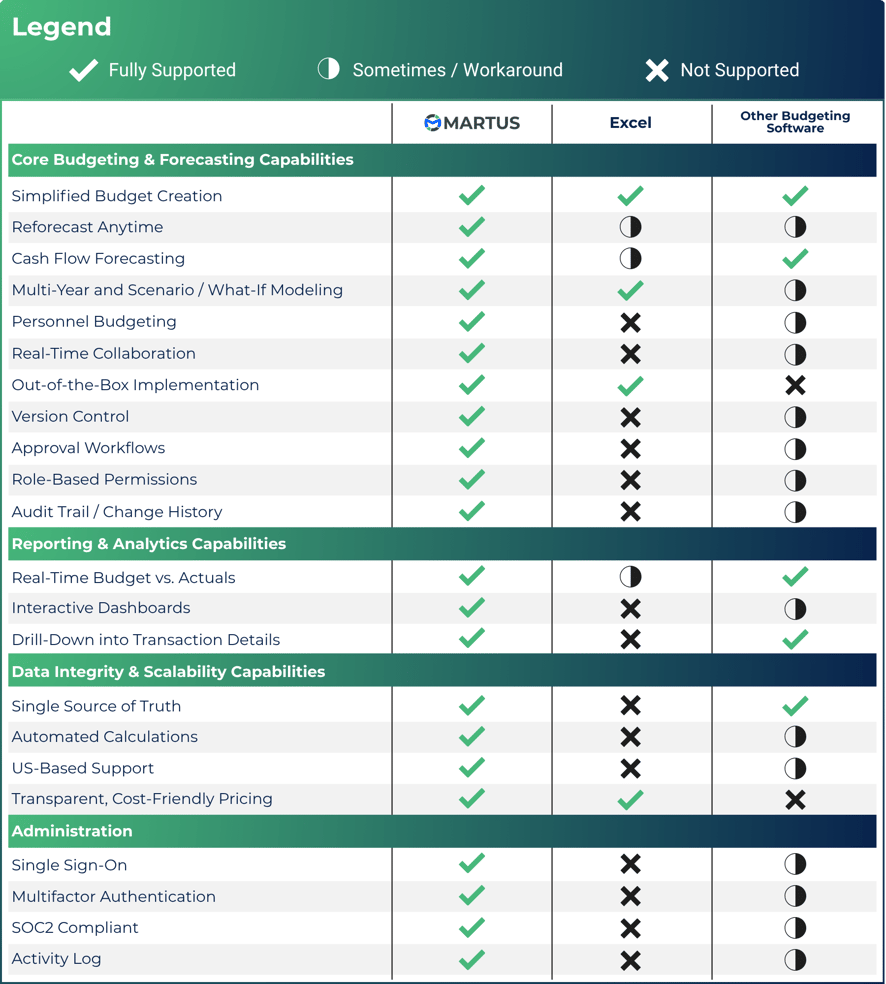
Unlike many budgeting platforms that require months to deploy, Martus is designed for rapid implementation and quick time-to-value. Many organizations begin seeing benefits within weeks, not months.
Budgeting software shouldn't require an enterprise-sized budget.
Martus offers predictable, transparent pricing designed for nonprofits, mission-driven organizations, and small-to-mid-sized businesses. Organizations gain advanced planning capabilities without unexpected costs or complicated licensing structures.
One of the biggest barriers to adopting new financial software is implementation.
Martus eliminates much of that friction through a streamlined deployment process that minimizes IT involvement and reduces the need for extensive consulting engagements. Finance teams can begin using the platform quickly and focus on planning rather than system setup.
Unparalleled Support
Martus provides U.S.-based support from finance professionals who understand budgeting, forecasting, and reporting challenges. Customers work directly with experienced experts who remain engaged long after implementation, helping teams maximize the value of their investment.
.png?width=905&height=209&name=Title%20(18).png)
Martus is powerful enough for finance teams and intuitive enough for non-finance leaders.
That means less time spent chasing versions, fewer reporting bottlenecks, more collaboration, and greater accountability across your organization.




.png)