

Skip to the main content.


Smarter Financial Reporting

Turning financial data into strategic insight for leadership teams that need reporting beyond compliance — with the clarity and context to make confident decisions.


Turning Financial Data Into Strategic Insight

Financial reporting plays a critical role in helping leadership teams understand the current and future health of their organization. Yet many finance teams struggle with reports that are difficult to interpret, overly complex, or disconnected from the organization’s priorities.

Finance teams at nonprofit organizations, growing companies, and mission-driven institutions all need reporting that goes beyond compliance and historical reporting.

In this guide, organizations can learn how to improve financial reporting to create greater clarity, stronger transparency, and better strategic alignment and accountability.

Why Financial Reporting Matters

Financial reports are one of the primary ways leadership teams and stakeholders evaluate the financial performance of an organization.

However, traditional financial reports often present large volumes of data without providing the context needed to interpret it effectively and make forward-looking decisions. According to the Maximor Finance AI Adoption Benchmarking Report, strategy stalls when data is doubted.

When financial information lacks clarity, organizations struggle to:

Identify emerging financial risks

Evaluate operational performance

Make informed strategic decisions

Effectively identify opportunities for further investment

Communicate financial results to Board members and team leaders

Effective reporting transforms financial data into meaningful insights that support better organization-wide decision-making.

Understanding Your Audience

Different stakeholders rely on financial reports for different reasons.

Finance leaders must often communicate financial information to audiences that vary widely in their financial expertise.

Effective financial reports present information in ways that are accessible and actionable for all of these audiences.

1

Executive Leadership

Leaders need high-level financial insights that help guide strategic decisions.

2

Boards and Governing Bodies

Boards require financial transparency and clear visibility into financial health and sustainability.

3

Department Leaders

Team leaders need financial information that helps them manage budgets and evaluate performance.

4

Program Managers

Frontline leaders often help guide budget allocations by aligning funding with program priorities, ensuring resources are used effectively to maximize impact.

5-Sep-01-2026-02-28-10-6548-PM

Key Elements of Effective
Financial Reporting

Strong financial reports should answer several key questions:
     • How is the organization performing financially?
     • How does actual performance compare to financial plans?
     • What trends should leadership be aware of?
     • What risks or opportunities are emerging?

The five key elements every financial report should include are:
1. Budget vs. actual comparison
2. Variance analysis
3. Trend analysis over time
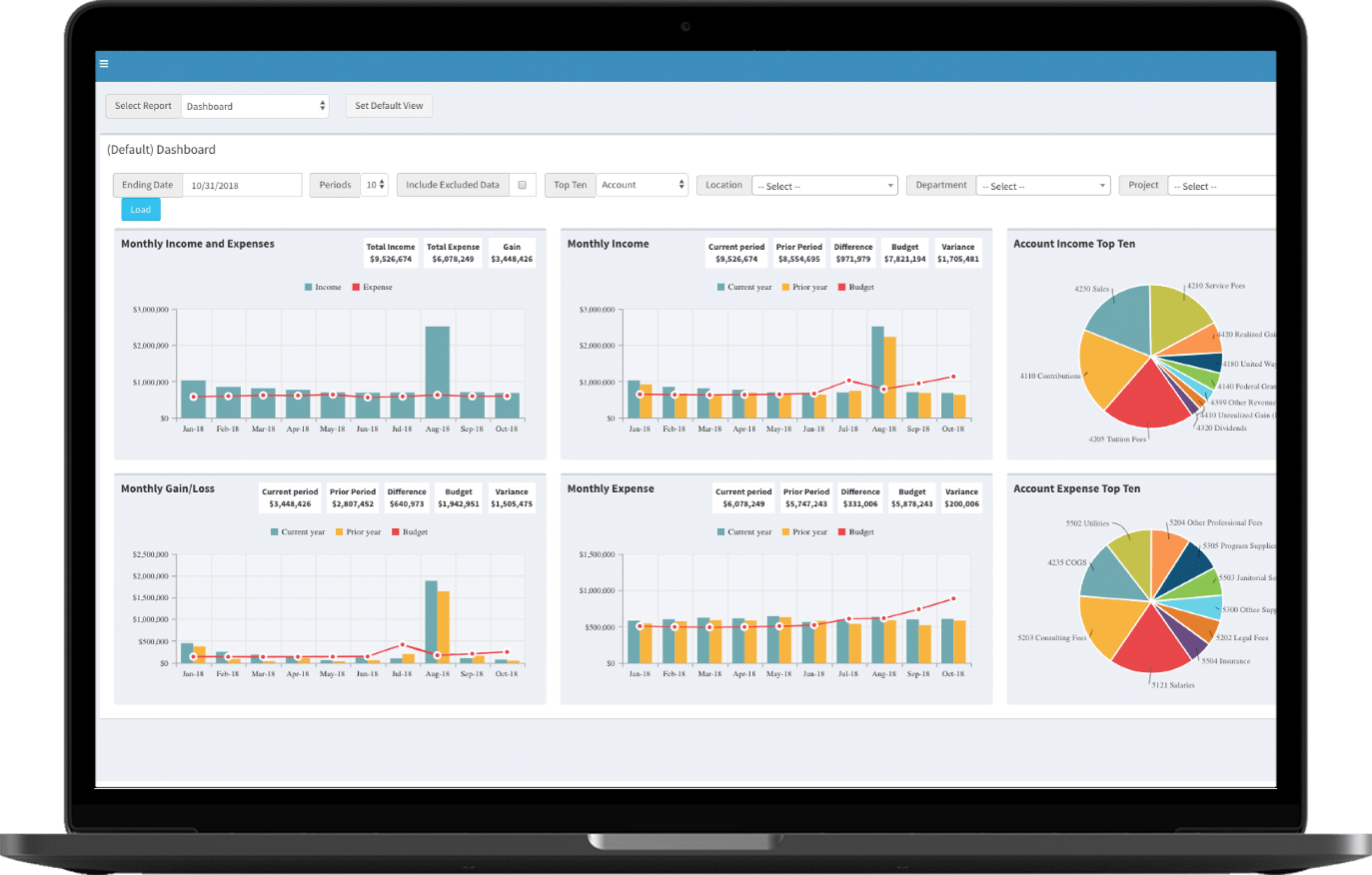
4. Visual dashboards and charts
5. Narratives that provide context

Turning Numbers Into Insight

Numbers alone rarely tell the full story. Effective financial reporting combines quantitative data with clear explanations that help leadership understand what the numbers mean. For example, instead of simply reporting a budget variance, finance teams can explain the context behind the data to help decision-makers focus on implications rather than raw figures.

What Caused the Variance

Identify the specific factors that contributed to the difference between actual and budgeted performance.

Temporary or Structural?

Clarify whether the change is a one-time occurrence or a signal of a longer-term shift that requires attention.

Actions to Consider

Outline what steps leadership may need to take in response to the variance or emerging financial trend.

Forward-Looking Next Steps

Help decision-makers focus on the implications of financial performance rather than simply reviewing raw data.

Building a Culture of Financial Transparency

Clear financial reporting builds trust with stakeholders - including employees, members, donors, and the community - and strengthens organizational governance.

"Financial transparency will help preserve the important trust community members and donors place in a nonprofit."

-National Council of Nonprofits

For finance leaders, improving reporting is not simply about producing better reports. It is about enabling better conversations, stronger accountability, and more confident decision-making. Learn how to build trust with donors and communicate financial confidence.

Build Trust with Stakeholders

Transparent financial reporting signals organizational integrity and builds long-term credibility with boards, donors, and the broader community.

Strengthen Governance

When boards have access to clear, consistent financial information, governance improves - enabling more informed oversight and better strategic direction.

Drive Accountability

Financial transparency creates shared accountability across the organization, ensuring resources are aligned with priorities and that leadership is empowered to act on what the data reveals.

Untitled design (32)-1

Leveraging Technology for
Modern Reporting

Many finance teams still spend significant time manually compiling reports from multiple systems and spreadsheets. This manual process can slow reporting cycles and increase the risk of errors. Modern financial planning and reporting platforms help finance teams automate data consolidation, improve accuracy, and generate reports more efficiently.

The Strategic Role of Finance

Today's finance teams are increasingly expected to provide strategic insight rather than simply reporting historical performance. Modern financial reporting supports this shift by enabling finance leaders to identify trends, model potential outcomes, and help leadership evaluate strategic decisions.

"Most nonprofits aren't short on financial data. They're short on connection between the systems, departments, and stakeholders that data is supposed to serve."

— Taylor Macdonald,
CEO, Martus Solutions

From Reporting to Insight

When reporting evolves from static documents into dynamic insights, finance teams become critical partners in guiding organizational strategy rather than simply recapping past performance.

Identifying Trends and Opportunities

Modern financial reporting tools enable finance leaders to surface emerging patterns in revenue, expenses, and program performance — helping leadership stay ahead of change rather than react to it.

Building Financial Transparency

Clear financial reporting builds trust with stakeholders — including employees, members, donors, and the community — and strengthens organizational governance across every level.

Supporting Confident Decision-Making

When leadership teams and boards have access to transparent, well-presented financial insights, they are better equipped to make decisions that support long-term success and sustainability.

Featured Insights

Ready to Ditch the Spreadsheets?

Chat with our team to see how Martus can help you improve your budgeting and reporting in as little as two weeks. 

Notice of Collection

Martus Solutions LLC (“Martus”) collects information you submit in this form and certain information about your device and use of this page. We use that information to respond to your request, schedule and personalize any demonstrations, manage our sales relationships, operate and improve our website, protect security, conduct analytics, and market our services.

Certain online identifiers and website activity may be shared with advertising and analytics partners for cross-context behavioral advertising.

Martus does not intend to collect sensitive personal information through this form. Do not enter account passwords, government identification numbers, financial account information, precise geolocation, or other sensitive personal information into any field.