

_EasiestSetup_Small-Business_EaseOfSetup.svg)
.webp?width=76&height=76&name=SOC2-blue%20(1).webp)
 Martus Solutions

Martus Solutions Founder Bill Cox Receives Inaugural Servant Leader Award at Faith-Based Finance Collaborative
New Baker Tilly-presented award recognizes leaders making a lasting impact in faith-based finance.
Read More
There’s no doubt that AI is transforming traditional budgeting and forecasting by replacing slow, manual processes with faster, efficient, and more collaborative financial processes.
But what does this transformation mean for your organization? How can your nonprofit leverage AI to enhance financial stewardship?
As automation and real-time data become increasingly important, the shift to AI-driven tools matters now more than ever.
You'll want to help your finance leaders drive financial clarity, accountability, transparency, and impact in every dollar spent.
Let's explore how to use AI in budgeting and forecasting, the benefits, and the best tool to help you cover various use cases.

|

|
Artificial intelligence is shaking things up in the financial world, especially in budgeting and forecasting. While we can chalk up some of the excitement to hype, there are real, measurable advancements in the field.
Modern AI-based tools are not only automating manual processes but also enabling intelligent and faster data-informed decision-making.
The key is to tell the difference between what's possible today and what remains a distant dream. Here's a quick look at what's hype and what's real:
AI is actively transforming financial forecasting by analyzing vast datasets to uncover trends and predict likely outcomes with greater accuracy.
Cloud-based AI-powered financial management tools are already reducing human error and speeding up forecasting cycles.
Modern AI-driven financial management platforms enhance cross-departmental collaborative budgeting.
For example, with Martus, both financial and non-financial teams can align input in real time, streamlining the entire budgeting process.
Unlike traditional tools, AI systems learn from past human behavior and data to get more intelligent over time.
Ongoing learning and improvement mean forecasts and budgets are becoming increasingly refined, offering businesses and organizations a more competitive advantage.
Even as AI can assist and accelerate financial operations, the idea of a totally self-running finance department remains more hype than reality. Human oversight, strategy, and judgment are still irreplaceable.
The bottom line is that AI in financial management is far from a passing buzz. It's already reshaping how organizations and businesses operate.
Some vendors claim AI will automate finance fully. Whether it happens or not, AI’s real value lies in boosting collaboration, accuracy, and speed.
So, what exactly does it mean to use AI in budgeting and forecasting?

AI in financial budgeting and forecasting is the use of intelligent software that mimics human thinking to help finance teams plan, predict, and manage budgets more effectively.
Here's the basic automation-based working mechanism of AI budgeting and forecasting systems:
Finance teams don't have to rely solely on erratic spreadsheets and manual data input anymore.
AI tools can automatically gather, integrate, and analyze financial data. They can recognize trends or patterns, flag anomalies, and generate detailed forecasts based on historical financial trends.
All these activities happen in a fraction of the time it would take a human, which means finance leaders get more accurate projections, faster insights, and fewer surprises in their planning cycles.
AI also takes over repetitive tasks such as data synchronization, report generation, and budget variance analysis.
Removing manual burdens frees up time that the finance team can dedicate to high-value tasks like strategy and budget projection.
We’ve already mentioned that AI-powered financial planning is quite different from the traditional model.
Let's dive deeper into how they differ:
| Aspect | Traditional Planning (Spreadsheets) | AI-powered Planning (Modern Tools) |
| Data entry | Manual and time-consuming | Automated data integration from diverse sources |
| Accuracy | Prone to human error | High accuracy through trend recognition and anomaly detection |
| Collaboration | Siloed and plagued by version control issues | Real-time, usually cloud-based |
| Forecasting | Based on static historical data | Dynamic, data-driven forecasting using AI insights |
| Efficiency | Slower processes and heavy administrative workload | Streamlined workflows with reduced manual input |
| Scalability | Difficult to scale with growing data | Easily scales with organizational and data growth |
With modern tools, you get futuristic solutions that combine automation, intelligence, and accuracy into everyday financial planning and management.

Unlike their traditional counterparts, modern financial management and planning have AI built into tools in various ways. These may include:

Once you integrate an AI system with these core features, you can unlock faster and more collaborative budgeting and forecasting that directly support your organization's goals through:
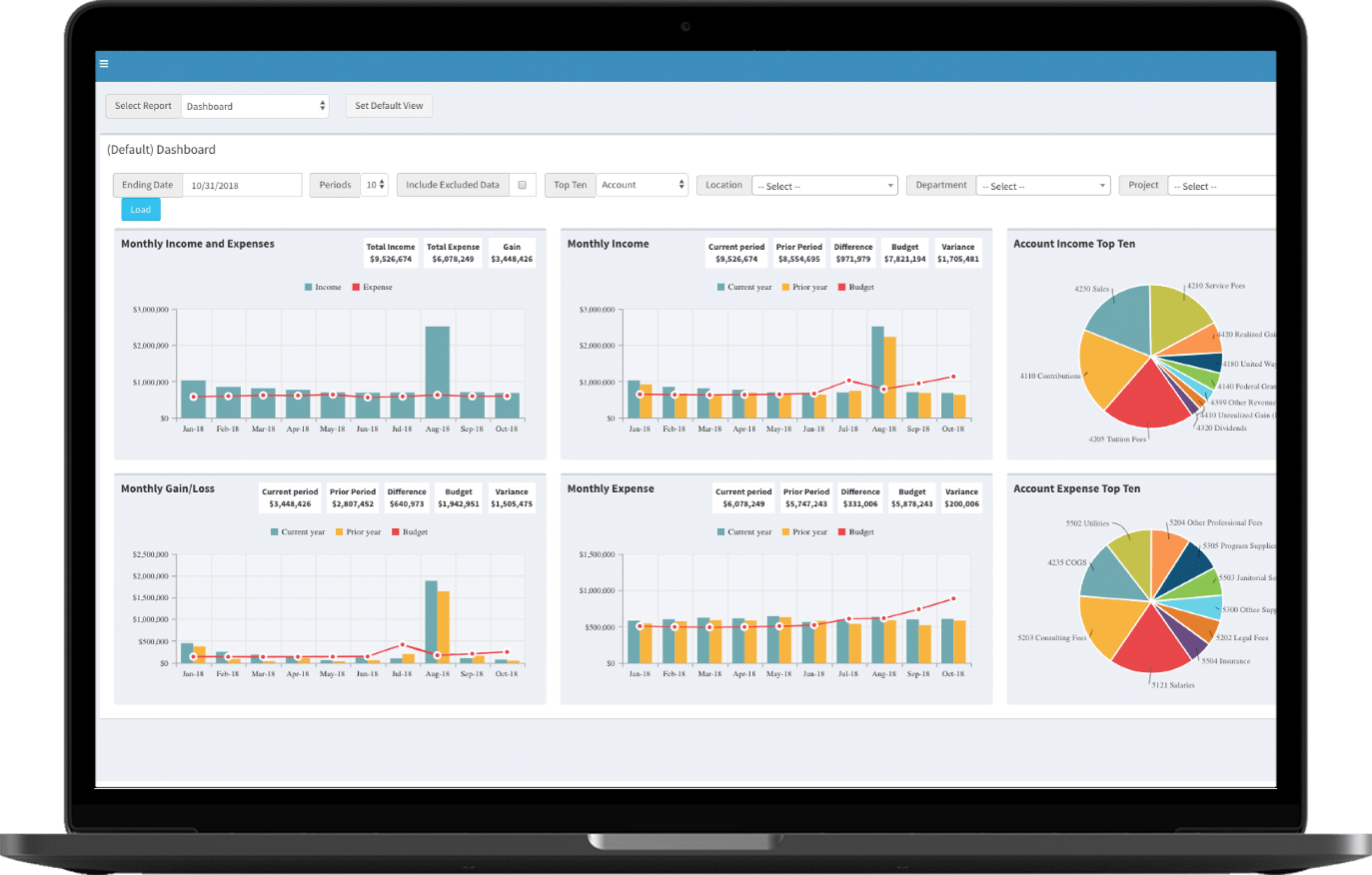
With Martus, our dedicated nonprofit financial management platform, you can enjoy all these benefits and some more.
You gain control and clarity over your nonprofit finances, ensuring you are more confident about your financial future.

Martus helps you realize these benefits through the following features and capabilities:
Ready to ditch traditional financial management systems?
|
|
|

Once you have the right tool, you can leverage AI financial forecasting and budgeting through the following use cases to capture the above benefits:
These applications support better stewardship, faster planning cycles, and more strategic use of every dollar to promote long-term financial sustainability.

As we've seen, implementing AI-driven financial management brings clear budgeting and forecasting benefits, but you’ll have to overcome some common hurdles to succeed.
These hurdles may include:

Let's end today's discussion with some questions about AI in budgeting and forecasting:
Predictive analytics falls under artificial intelligence and uses historical financial data to forecast future outcomes. For example, you can project seasonal giving or program expenses based on past giving or spending trends.
AI as a whole expands on this capability by continuously learning from new financial data to adapt forecasts as conditions change.
For instance, after noticing an unexpected shift in donation patterns, AI can make real-time adjustments to projections to ensure more accurate and responsive financial management.
AI is here to enhance the impact of your financial team rather than replace roles like financial analysts.
While it can handle data-heavy tasks like anomaly detection, variance analysis, and forecasting, AI still relies on human judgment for context, strategic decisions, and mission alignment.
Martus empowers your financial team by removing manual burdens and surfacing smarter insights, ensuring they can focus more on planning, fundraising, and advancing your mission.
Most modern AI tools are easy to use, meaning your finance teams don't require coding skills or technical expertise to get started.
Your team's focus should be on understanding AI-generated insights and learning how to interpret data for better decision-making.
The intuitive interfaces and guided onboarding systems in most tools mean that your team can adapt quickly and reap the benefits of AI budgeting, planning, and forecasting sooner.
The use of AI in budgeting and forecasting isn't a passing trend. AI is actively reshaping how organizations manage restricted and unrestricted resources, plan strategically, and drive lasting impact.
To stay ahead, you should explore a dedicated, cloud-based collaborative tool that integrates AI to streamline processes, ensure accuracy, and future-proof financial operations.
Martus can do these and much more as a dedicated nonprofit financial management platform.
Martus applies AI to budgeting and forecasting use cases such as fund accountability, expense forecasting, and budgeting through a quick implementation process that takes only two weeks.
With Martus, you don’t have to worry about the data security concerns related to using AI, such as data breaches or leaks. Your personal and financial data is protected at all times through SOC 2 compliance and Certified App Security.
Streamline your nonprofit’s budgeting and forecasting processes with AI solutions with Martus. Learn more today!
|
|
|
.png)