Martus vs. Solver
Leave spreadsheet complexity behind with purpose-built planning, reporting and AI for mission-driven teams.

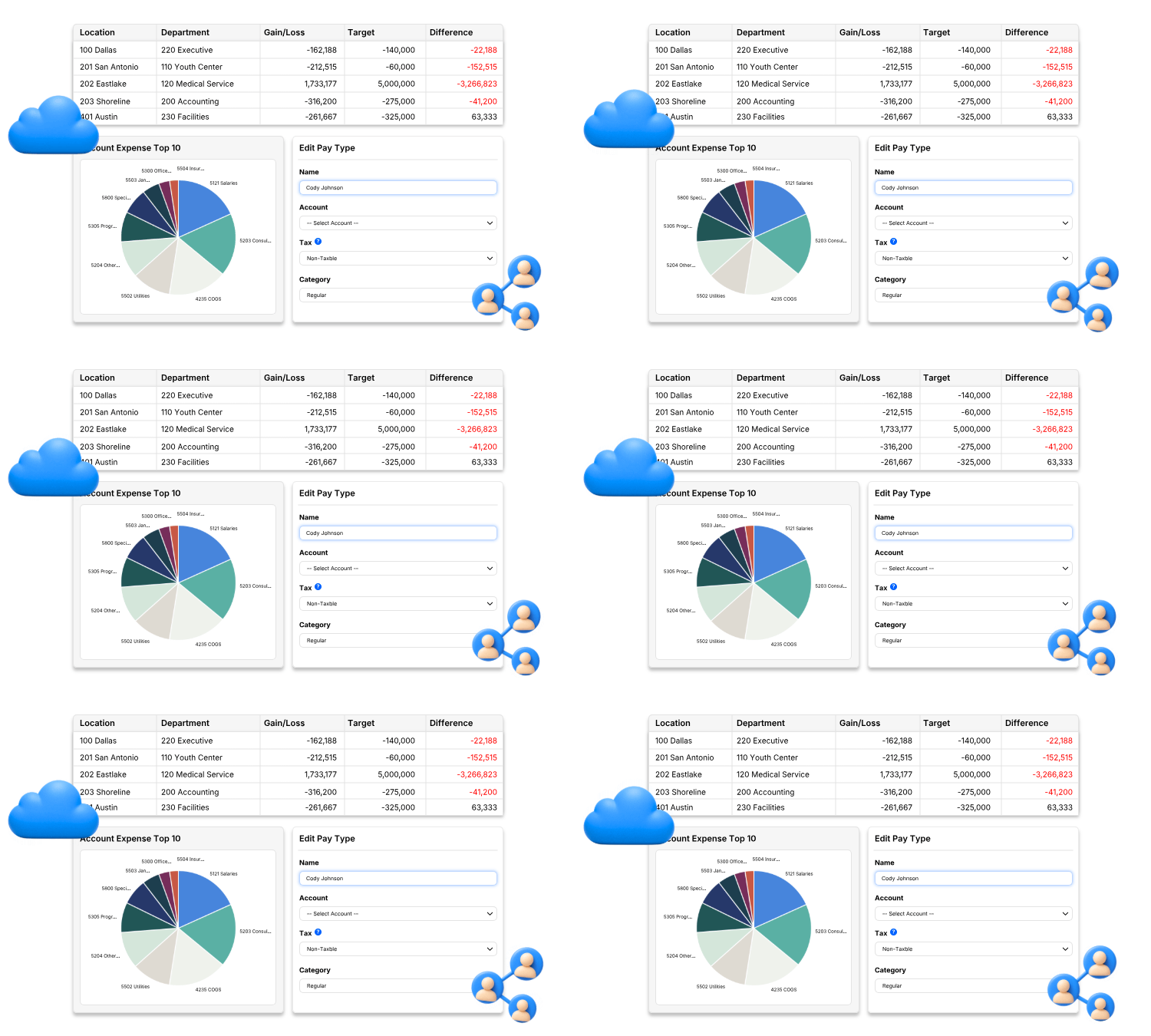
Martus and Solver both connect planning, forecasting, reporting, and analysis. The difference is the experience each platform is built around. Solver extends a familiar Excel design model into a broad FP&A suite. Martus gives finance and operational teams a purpose-built web experience designed to make budgeting easier to build, participate in, explain, and maintain.
For organizations that need complex enterprise-level consolidation, a data warehouse, and highly customized Excel-designed reports, Solver can be a strong option. For nonprofits and mission-driven organizations that want faster implementation and adoption, easy department collaboration, personnel and grant planning, transaction-level visibility, and scalable packages, Martus offers a purpose-built solution.
Choose the platform that matches how your whole organization plans, not only how finance builds reports.












Collaborative Planning that Works Beyond the Finance Team
A Cloud-Based Solution, Not an Excel Design Layer
Martus moves budgeting, forecasting, reporting and collaboration into one browser-based platform. Budget owners work in guided worksheets and role-specific views without learning complex formulas or relying on finance to build and maintain Excel input forms. This reduces spreadsheet dependence, distributes ownership across the organization and gives finance more time to analyze results instead of administering the process.
Organizations trying to reduce spreadsheet dependency should evaluate how much design, administration, and specialized knowledge a solution like Solver would require.
Built Around Nonprofit Budgeting Realities
Built around the financial needs of nonprofits, churches, schools, associations and other mission-driven organizations, Martus supports personnel allocations, grants, programs, funds, departments, locations, projects and other accounting dimensions in one connected platform. Its guided workflows help organizations manage financial complexity without relying on custom templates or Excel-designed forms.
Buyers should compare how much of their process is ready to use versus how much must be configured in templates and Excel-designed forms.
Personnel Planning that Goes Beyond Headcount
Martus helps organizations plan salaries, bonuses, benefits, payroll taxes, raises, vacancies and mid-year changes in a dedicated personnel budgeting workflow. Teams can allocate employee costs across grants, programs, departments, funds and other accounting dimensions while using granular permissions to protect sensitive compensation data. This gives finance a clearer, more controlled way to manage one of the organization’s largest and most complex expenses.
Solver’s prebuilt planning templates may provide the flexibility to design custom personnel budget forms using Excel, which could benefit finance teams with strong spreadsheet expertise and highly customized requirements.
Martus vs. Solver - At A Glance
| G2 Category | Martus | Solver |
| Ease of Admin |  92% 92% |
 85% 85% |
| Ease of Setup | .png?width=332&height=20&name=89%20(1).png) 89% 89% |
 78% 78% |
| Ease of Use |  90% 90% |
 81% 81% |
| Quality of Support |  98% 98% |
 90% 90% |
-1.png?width=150&height=38&name=Untitled%20design%20(64)-1.png)
Data provided by G2 Fall 2026 User Satisfaction Ratings report.
Can the Whole Team Participate Without Becoming Excel Experts?
Martus is designed for finance teams and the department leaders who own the assumptions behind the budget. Administrators can tailor access by role, account, department, and accounting dimension so each participant sees the work relevant to them.
Martus
Browser-based guided worksheets
Role- and dimension-based access
Designed for finance and nonfinance budget owners
Solver
Business users enter data through a web portal
Finance designs forms through Excel
Standard, Contributor, and Viewer licenses serve different access needs
Can I Actually Move Beyond Excel?
With Martus, yes. Excel can still be used for optional exports, but it is not the required design environment for budgeting and reporting. Teams work from connected data, permissions, dashboards, worksheets, and reports inside Martus.
Martus
Purpose-built browser experience
Reports and input workflows managed in-platform
Excel exports remain optional
Solver
Native Excel design is a core product benefit
Budget forms and reports are created with familiar Excel tools
Web delivery reduces workbook collection but not Excel-based design
Can I Plan Grants and Personnel Together?
Martus is purpose-built for the dimensions and cost structures mission-driven organizations manage every day. Finance teams can allocate personnel costs, budget by grants and programs, and report across funds, departments, projects, locations, and other dimensions connected to the accounting system.
Solver offers personnel planning through configurable templates.
Martus
Personnel planning across dimensions
Grant and program budget-to-actuals
Reusable worksheets and reporting groups
Solver
Configurable nonprofit templates
Excel-designed planning forms
Enterprise consolidation and data-warehouse depth
Can I Reforecast Quickly When Plans Change?
Martus
Reforecast from budgets and current actuals
Keep approved plans available for comparison
Choose the forecasting depth that matches your organization
Solver
Weekly, monthly, or quarterly rolling forecasts
Unlimited budget versions
Top-down and bottom-up models built through configurable forms
How Can AI Help My Finance Team?
In Martus, AI supports your finance team with AI report creation, in-product guidance, and answers to questions about budgets, forecasts, and performance. ReportBuilder Assistant helps users create and refine reports with natural language, Ask Marty provides product guidance, and Martus Intelligence is designed to surface summaries, visualizations, and actionable insights. Learn more about Martus’ AI innovation.
Solver Copilot also brings AI into FP&A. Buyers should compare the exact agents, licenses, and data workflows included in their quote.
Martus
Natural-language report creation
Planning-specific help inside Martus
Conversational insight grounded in budgets and forecasts
Solver
Help Agent for product and formula questions
Analysis Agent for anomalies and predictive recommendations
Copilot included with Standard User licenses; verify access for other roles
Trusted by Thousands of Nonprofit Customers
"Martus Solutions has been a real asset in evolving our budgeting process. By moving us away from manual Excel spreadsheets, the focus has shifted from just creating to actual management of our budgetary cycle."
 Laila Bueckers
Controller
Laila Bueckers
Controller
"Martus allows my entire team to keep tabs on our budget seamlessly and plan out our finances with ease. The added efficiency and speed with which we got things up and running are massive pluses."
 Bill Schankel
COO
Bill Schankel
COO
"Ditching the endless Excel sheets and cutting costs on software licenses we didn't need anymore was a breath of fresh air. Martus is secure, easy to use, and the accuracy is spot-on. Plus, with a quick implementation, we were up and running in no time."
.png?width=52&height=52&name=Untitled%20design%20(24).png) Chris Ockerman
Director of Administration
Chris Ockerman
Director of Administration
"Martus has helped our business streamline the entire budgeting process tremendously. We used to do everything on individual spreadsheets, and now it's all in one place, which helps all our managers monitor everything more efficiently as well."
 Allison Hickman
VP of Administration
Allison Hickman
VP of Administration
"The Martus software is a key tool in my day to day financial analysis, including comparing actuals versus budgeted costs. It's very user friendly and provides an easy bridge from our data in Sage Intacct."
-1.png?width=52&height=52&name=Untitled%20design%20(42)-1.png) Matthew Bredes
CFO
Matthew Bredes
CFO





| What You Need | Martus | Solver |
|---|---|---|
|
Core Experience
|
Browser-based budgeting, forecasting, reporting, and collaboration
|
Excel-native design with web delivery
|
|
Best Fit
|
Nonprofits, churches, schools, associations, mission-driven organizations, and SMBs
|
Mid-market and enterprise teams seeking broad xFP&A, consolidation, and data warehousing
|
|
Budget Participation
|
Guided worksheets with role- and dimension-based access
|
Web input forms designed through the native Excel experience
|
|
Nonprofit Planning
|
Personnel allocations, grants, programs, funds, departments, projects, and locations
|
Fund-based budgeting and grant-planning templates that can be configured
|
|
Reporting
|
Custom reports, dashboards, KPIs, variance analysis, and transaction drill-down
|
Excel-designed financial and operational reporting with drill-down and scheduled delivery
|
|
Scenarios
|
Reforecast anytime; multi-year what-if and cash-flow capabilities available by package
|
Rolling forecasts, automatic spreading, and unlimited budget versions
|
|
AI
|
ReportBuilder Assistant, Ask Marty, and conversational financial insight
|
Copilot Help and Analysis agents; Analysis Agent availability is listed for the United States
|
|
G2 Rating
|
4.7 out of 5 from 102 reviews as of September 2026
|
4.5 out of 5 from 270 reviews as of September 2026
|
|
Published Pricing
|
Essentials starts at $6,650 annually, with nonprofit and church discounts
|
Custom quote with Standard, Contributor, and Viewer license types
|
Frequently Asked Questions
Should I choose Martus or Solver?
Choose Martus if your priority is intuitive browser-based collaboration, nonprofit and mission-driven expertise, personnel and grant planning, rapid adoption, transparent packages, and planning-specific AI. Choose Solver if your organization wants Excel-native design, enterprise consolidation, a built-in data warehouse, and extensive customization across a broader xFP&A environment.
Is Solver an Excel replacement?
Not in the same way Martus is. Solver eliminates emailed workbook collection and adds cloud workflows, controls, and web delivery, but it intentionally uses native Excel as the design experience for reports and budget forms. Martus keeps the core budgeting and reporting workflow in a purpose-built browser platform.
Can my whole team use either platform?
Yes. Martus supports finance and nonfinance users through role- and dimension-based permissions, with licenses expandable in five-user packs. Solver offers Standard, Contributor, and Viewer user types. Compare the access each role needs and price the full participant group, not only the finance administrators.
Which platform is better for nonprofits?
Both support nonprofit use cases. Martus is purpose-built around nonprofits and mission-driven organizations, with personnel allocations, grants, programs, funds, departments, projects, and locations embedded in its planning model. Solver offers nonprofit templates and strong enterprise reporting and consolidation. The better fit depends on whether your priority is ready-to-use nonprofit workflows or a highly configurable Excel-native xFP&A suite.
Can Martus handle multi-entity reporting?
Yes. Martus synchronizes the entities and accounting dimensions used in connected systems and supports reporting across them with transaction drill-down. Solver goes further for organizations requiring dedicated consolidation features such as currency translation, eliminations, and process management. Buyers should demonstrate their exact consolidation requirements in both products.
Do both products support rolling forecasts and scenarios?
Yes. Martus supports reforecasting across packages and offers advanced multi-year, what-if, cash-flow, and projected balance-sheet capabilities in higher packages. Solver supports rolling forecasts at multiple cadences, automatic spreading, top-down and bottom-up planning, and unlimited budget versions.
How do reporting and drill-down compare?
Martus provides customizable reports, dashboards, KPIs, variance analysis, and transaction-level drill-down in a browser-based workflow. Solver provides flexible Excel-designed financial and operational reports, source-data drill-down, scheduled distribution, and complex consolidation reporting. The key choice is whether your team prefers purpose-built web reporting or Excel-native design flexibility.
How quickly can each platform be implemented?
Martus reports that most organizations complete onboarding and training within three weeks, with some implementations completed in as little as one week. Solver says most QuickStart customers go live in days using pre-built ERP connectors and marketplace templates. Actual timing for either platform depends on data readiness, integrations, entities, custom templates, and workflow complexity.
How does pricing compare?
Martus Essentials starts at $6,650 annually, with discounted pricing available for nonprofits and churches; final pricing depends on organization size, package, and users. Solver uses custom quotes and separates users into Standard, Contributor, and Viewer licenses. Compare subscription, implementation, consulting, integrations, AI access, and every user role required.
What happens as our planning needs grow?
Martus customers can add users and move into advanced forecasting, personnel planning, custom report building, cash-flow forecasting, projected balance sheets, and API access. Solver can expand into enterprise consolidation, data warehousing, complex reporting, and broader operational analysis. Choose based on the complexity you need now and the administration model your team can sustain.
-1.png?width=175&height=45&name=Untitled%20design%20(64)-1.png)
Ready to Move Beyond Spreadsheet Budgeting?
When you choose Martus, you choose:
A centralized budget process instead of disconnected files and versions
User permissions set and managed by finance leaders
Accounting integrations that keep actuals and dimensions connected
Transaction-level drill-down from summary results to supporting detail
Reforecasting that preserves the approved plan for comparison
AI-powered report building, guidance, and financial insight
See what budgeting looks like when your people and plans are connected.